> ## Documentation Index
> Fetch the complete documentation index at: https://docs.consensus.app/llms.txt
> Use this file to discover all available pages before exploring further.
# Citation Graph
> Citation Graph is a visual way to explore how papers connect. Start with up to 5 seed papers you trust and discover related work through citation relationships instead of keywords.
Citation Graph maps how research papers connect through citations. Instead of running a keyword search, you start with papers you already trust (**seeds**) and discover related work based on how the literature cites itself.
Use it to find papers you missed, identify foundational and follow-up research, see how a field evolved, and spot clusters and gaps. It's included with every Consensus account.
## How to build a graph
Click **Graph** in the left sidebar, or click **Citation Graph** on any paper's sidebar to seed the graph with that paper.
Add up to 5 seed papers from your recently saved papers or by searching from the Graph page. One seed traces the lineage of an idea in both directions; several seeds find the overlap between literatures.
Show 20, 40, or 60 papers.
Hover a paper to see its citation connections. Click into a paper for details. **Promote** a result to a seed to regenerate the graph around it, or **Exclude** papers you don't want.
Click **Chat** at the bottom of the page. All seeds and results are attached as context, so you can ask how papers connect, how the research built on earlier work, or what patterns emerge.
## How papers are ranked
Citation Graph doesn't use keyword matching. It combines three citation signals:
* **Direct citations** — the paper cites your seed, or your seed cites it.
* **Co-citation** — how often the paper and your seed appear together in other papers' reference lists.
* **Bibliographic coupling** — how many references the paper shares with your seeds.
A traditional citation crawl only looks forward or backward from one paper. Combining the three signals surfaces related work a crawl would miss.
## Reading the graph
| Element | Meaning |
| --------------- | -------------------------------------------------------------------------------------------- |
| Horizontal axis | Time — older papers on the left, newer on the right |
| Vertical axis | Approximate citation strength |
| Node size | Citation count |
| Color | Seed cluster — papers one hop from a seed take that seed's color; gray nodes bridge clusters |
| Opacity | How connected the paper is to the seeds |
| Arrows | Citation direction — an arrow points from a paper to the paper it cites |
A legend sits in the top-right corner. You can also sort and filter by citation count, journal rank (SJR), study design, and sample size.
## Questions to ask the graph
```text theme={null}
What do these papers say about [topic], and where do they disagree?
```
```text theme={null}
Which of these papers used a randomized design?
```
```text theme={null}
How did the later papers build on the earliest seed?
```
Citation Graph is in beta. Graphs aren't saved yet; closing or refreshing the page clears the graph.
## Related
Ask for citation chaining in plain language.
Save graph results into a Collection.
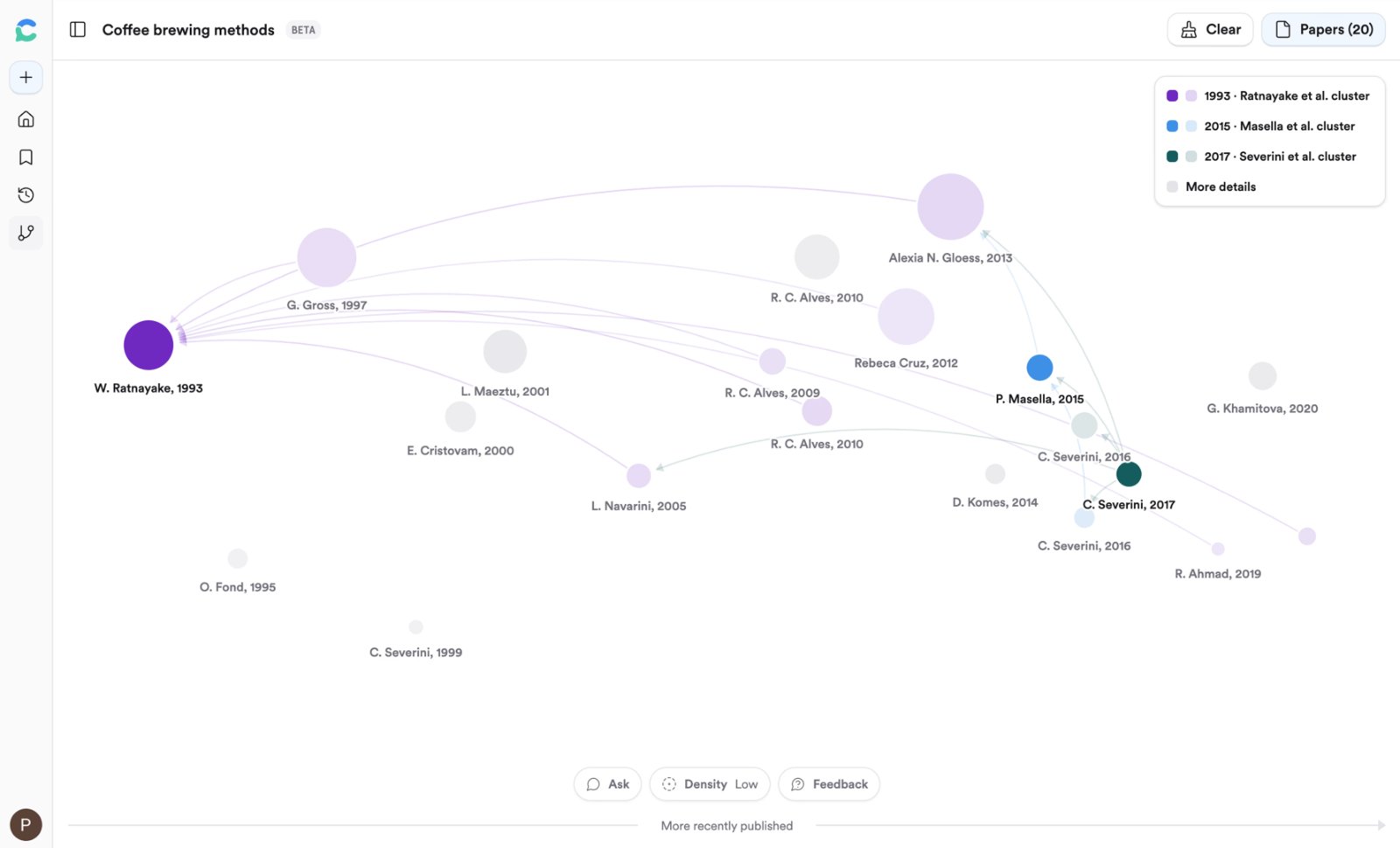 ## Reading the graph
| Element | Meaning |
| --------------- | -------------------------------------------------------------------------------------------- |
| Horizontal axis | Time — older papers on the left, newer on the right |
| Vertical axis | Approximate citation strength |
| Node size | Citation count |
| Color | Seed cluster — papers one hop from a seed take that seed's color; gray nodes bridge clusters |
| Opacity | How connected the paper is to the seeds |
| Arrows | Citation direction — an arrow points from a paper to the paper it cites |
A legend sits in the top-right corner. You can also sort and filter by citation count, journal rank (SJR), study design, and sample size.
## Questions to ask the graph
```text theme={null}
What do these papers say about [topic], and where do they disagree?
```
```text theme={null}
Which of these papers used a randomized design?
```
```text theme={null}
How did the later papers build on the earliest seed?
```
## Reading the graph
| Element | Meaning |
| --------------- | -------------------------------------------------------------------------------------------- |
| Horizontal axis | Time — older papers on the left, newer on the right |
| Vertical axis | Approximate citation strength |
| Node size | Citation count |
| Color | Seed cluster — papers one hop from a seed take that seed's color; gray nodes bridge clusters |
| Opacity | How connected the paper is to the seeds |
| Arrows | Citation direction — an arrow points from a paper to the paper it cites |
A legend sits in the top-right corner. You can also sort and filter by citation count, journal rank (SJR), study design, and sample size.
## Questions to ask the graph
```text theme={null}
What do these papers say about [topic], and where do they disagree?
```
```text theme={null}
Which of these papers used a randomized design?
```
```text theme={null}
How did the later papers build on the earliest seed?
```