> ## Documentation Index
> Fetch the complete documentation index at: https://docs.consensus.app/llms.txt
> Use this file to discover all available pages before exploring further.
# How search works
> Consensus finds the most relevant papers with hybrid search, re-ranks the top 1,500 by research quality, refines the top 20 with a larger model, and only then uses AI to synthesize an answer.
Consensus only uses AI after it searches the scientific literature. That ordering is what makes every answer traceable to a real paper. Here's the pipeline.
## Step 1: Cast a wide net
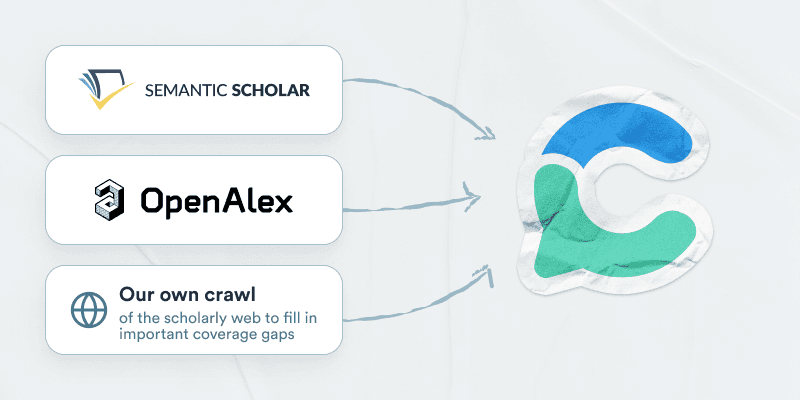
Consensus scans the entire 220-million-paper corpus and matches your query against titles, abstracts, and full text (when available) using a hybrid approach:
* **Semantic search**, powered by AI embeddings, captures the intent behind your question and supports natural-language queries.
* **Keyword search**, powered by BM25, anchors results to the exact terms in your query.
 Together they assign a relevance score to every paper. Consensus also rewrites typos, expands MeSH synonyms, and supports Boolean operators, so keywords, questions, and structured queries all work.
## Step 2: Refine by quality
The top 1,500 papers are re-ranked by blending the relevance score with research-quality signals:
* Recency of publication
* Citation count
* Journal reputation and impact
## Step 3: Rank the top 20 for precision
Consensus recalculates textual relevance on the top 20 papers using a larger, more compute-intensive model optimized for precision rather than broad recall. Quality signals still factor in, so the final list reflects both relevance and rigor.
## Step 4: Check relevance before writing anything
Before any AI summary is generated, separate checker models verify that each paper actually contains information relevant to the query. Papers that don't meet the threshold are excluded. If nothing relevant is found, Consensus tells you rather than letting a model fill in gaps that don't exist.
## Step 5: Analyze and synthesize
Once relevant papers are retrieved, AI is used in two ways:
* **Analyze individual papers** — for example, the Study Snapshot, which extracts population, sample size, duration, location, methods, outcomes, and results.
* **Synthesize across papers** — the Pro answer, the Consensus Meter, claims and evidence tables, research gaps heat maps, and timelines.
Models are instructed and trained to generate responses only from the text of the retrieved papers. Consensus uses commercial models (like OpenAI's) for general summarization and fine-tuned open-source models for domain-specific features like the Consensus Meter.
In Pro and Deep modes, [Research Agent](/core-features/research-agent) adds planning on top of this pipeline: it breaks a complex question into sub-searches, applies filters, walks the citation graph, reads across papers, and composes a citation-backed answer. [Deep Search](/core-features/deep-search) is the extended version: up to 20 searches in parallel, multiple agent tools like citation crawl, and 50 to 100 papers read before answering.
## Why hallucinations are contained
Consensus only searches its index of academic literature, and every source it cites is tied to a real academic paper.
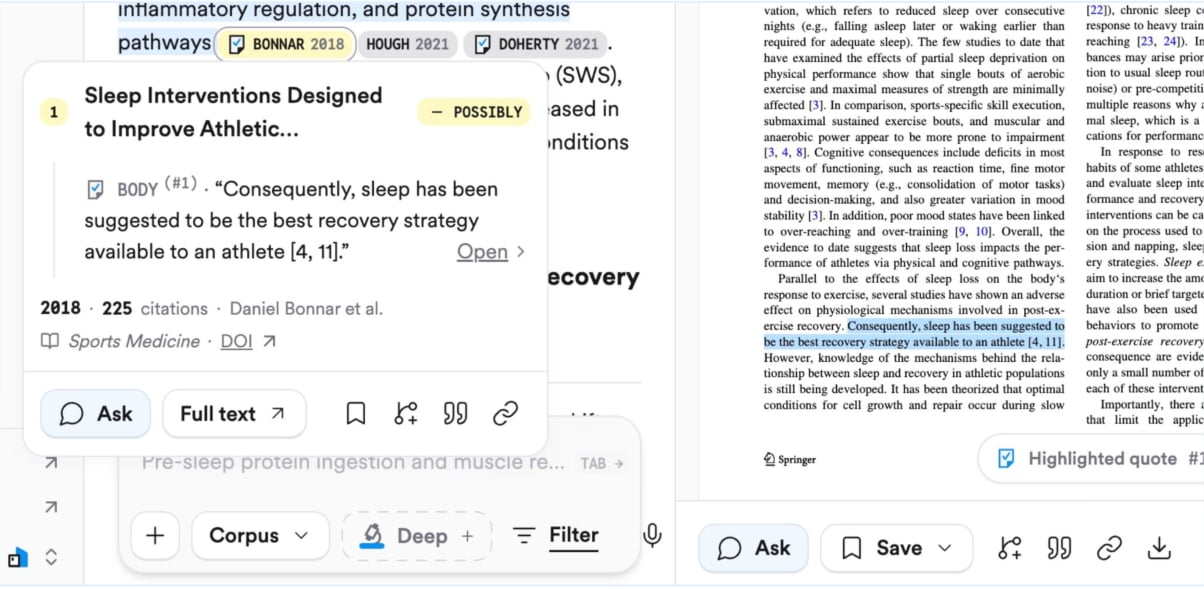
On top of that, Consensus has a number of guardrails built in to prevent hallucinations. The most important is [Citation Grounding](/core-features/citation-grounding), which shows you the exact sentence behind each claim and exactly where in the paper it comes from.
Together they assign a relevance score to every paper. Consensus also rewrites typos, expands MeSH synonyms, and supports Boolean operators, so keywords, questions, and structured queries all work.
## Step 2: Refine by quality
The top 1,500 papers are re-ranked by blending the relevance score with research-quality signals:
* Recency of publication
* Citation count
* Journal reputation and impact
## Step 3: Rank the top 20 for precision
Consensus recalculates textual relevance on the top 20 papers using a larger, more compute-intensive model optimized for precision rather than broad recall. Quality signals still factor in, so the final list reflects both relevance and rigor.
## Step 4: Check relevance before writing anything
Before any AI summary is generated, separate checker models verify that each paper actually contains information relevant to the query. Papers that don't meet the threshold are excluded. If nothing relevant is found, Consensus tells you rather than letting a model fill in gaps that don't exist.
## Step 5: Analyze and synthesize
Once relevant papers are retrieved, AI is used in two ways:
* **Analyze individual papers** — for example, the Study Snapshot, which extracts population, sample size, duration, location, methods, outcomes, and results.
* **Synthesize across papers** — the Pro answer, the Consensus Meter, claims and evidence tables, research gaps heat maps, and timelines.
Models are instructed and trained to generate responses only from the text of the retrieved papers. Consensus uses commercial models (like OpenAI's) for general summarization and fine-tuned open-source models for domain-specific features like the Consensus Meter.
In Pro and Deep modes, [Research Agent](/core-features/research-agent) adds planning on top of this pipeline: it breaks a complex question into sub-searches, applies filters, walks the citation graph, reads across papers, and composes a citation-backed answer. [Deep Search](/core-features/deep-search) is the extended version: up to 20 searches in parallel, multiple agent tools like citation crawl, and 50 to 100 papers read before answering.
## Why hallucinations are contained
Consensus only searches its index of academic literature, and every source it cites is tied to a real academic paper.
On top of that, Consensus has a number of guardrails built in to prevent hallucinations. The most important is [Citation Grounding](/core-features/citation-grounding), which shows you the exact sentence behind each claim and exactly where in the paper it comes from.
 Consensus is built to help researchers find relevant papers faster. As always, it's important to read the primary source material. Consensus has many features that show you exactly what's happening at each step of the process and exactly where in a paper information comes from, so you can save time and go straight to the paper itself.
## Next
How full text sharpens retrieval and analysis.
Video tutorials with the exact prompts.
Consensus is built to help researchers find relevant papers faster. As always, it's important to read the primary source material. Consensus has many features that show you exactly what's happening at each step of the process and exactly where in a paper information comes from, so you can save time and go straight to the paper itself.
## Next
How full text sharpens retrieval and analysis.
Video tutorials with the exact prompts.