> ## Documentation Index
> Fetch the complete documentation index at: https://docs.consensus.app/llms.txt
> Use this file to discover all available pages before exploring further.
# Run your first search
> Type a research question, pick what to search, and read what comes back. Keyword searches and full questions both work.
The fastest way to learn Consensus is to search something you care about. This lesson uses endometriosis as the example topic. Swap in your own.
## Step 1: Type your search
Go to [consensus.app](https://consensus.app) and type in the search bar. You can search two ways:
| Search style | Example | When it helps |
| - | - | - |
| Keywords | `endometriosis pain treatment` | You know the topic but not the question yet |
| A question | `What treatments reduce pain in endometriosis?` | You want a direct answer, with the evidence behind it |
Both work. Consensus matches the meaning of your search as well as the exact words, fixes typos, and understands medical synonyms. A clear question usually gets a more focused answer, so start with keywords if you're exploring and switch to a question once you know what you're asking.
Write the way you'd ask an expert colleague. "Does exercise help with depression in teenagers?" is better than "exercise depression".
## Step 2: Choose what to search (optional)
The search bar has a few controls. You can leave them all alone for your first search.
 * **+** adds sources. Attach papers or Collections from your Library, upload a PDF, connect Zotero, or open **Search corpus** to choose which papers are searched: **All** (400M+ papers), **Medical** (top medical journals and clinical guidelines), or **My Library** (papers you've saved).
* **Skills** runs a ready-made research workflow, such as a structured literature review. See [Skills](/core-features/skills).
* **Deep** switches on a much longer review. With it off, your search runs as a normal **Pro** search that reads up to 20 papers. See [Go deeper with Deep Review](/get-started/deep-review).
* **Filter** narrows results by year, study type, journal quality, and more. You can also just write filters into your search: "...published since 2020, RCTs only".
## Step 3: Read what comes back
* **+** adds sources. Attach papers or Collections from your Library, upload a PDF, connect Zotero, or open **Search corpus** to choose which papers are searched: **All** (400M+ papers), **Medical** (top medical journals and clinical guidelines), or **My Library** (papers you've saved).
* **Skills** runs a ready-made research workflow, such as a structured literature review. See [Skills](/core-features/skills).
* **Deep** switches on a much longer review. With it off, your search runs as a normal **Pro** search that reads up to 20 papers. See [Go deeper with Deep Review](/get-started/deep-review).
* **Filter** narrows results by year, study type, journal quality, and more. You can also just write filters into your search: "...published since 2020, RCTs only".
## Step 3: Read what comes back
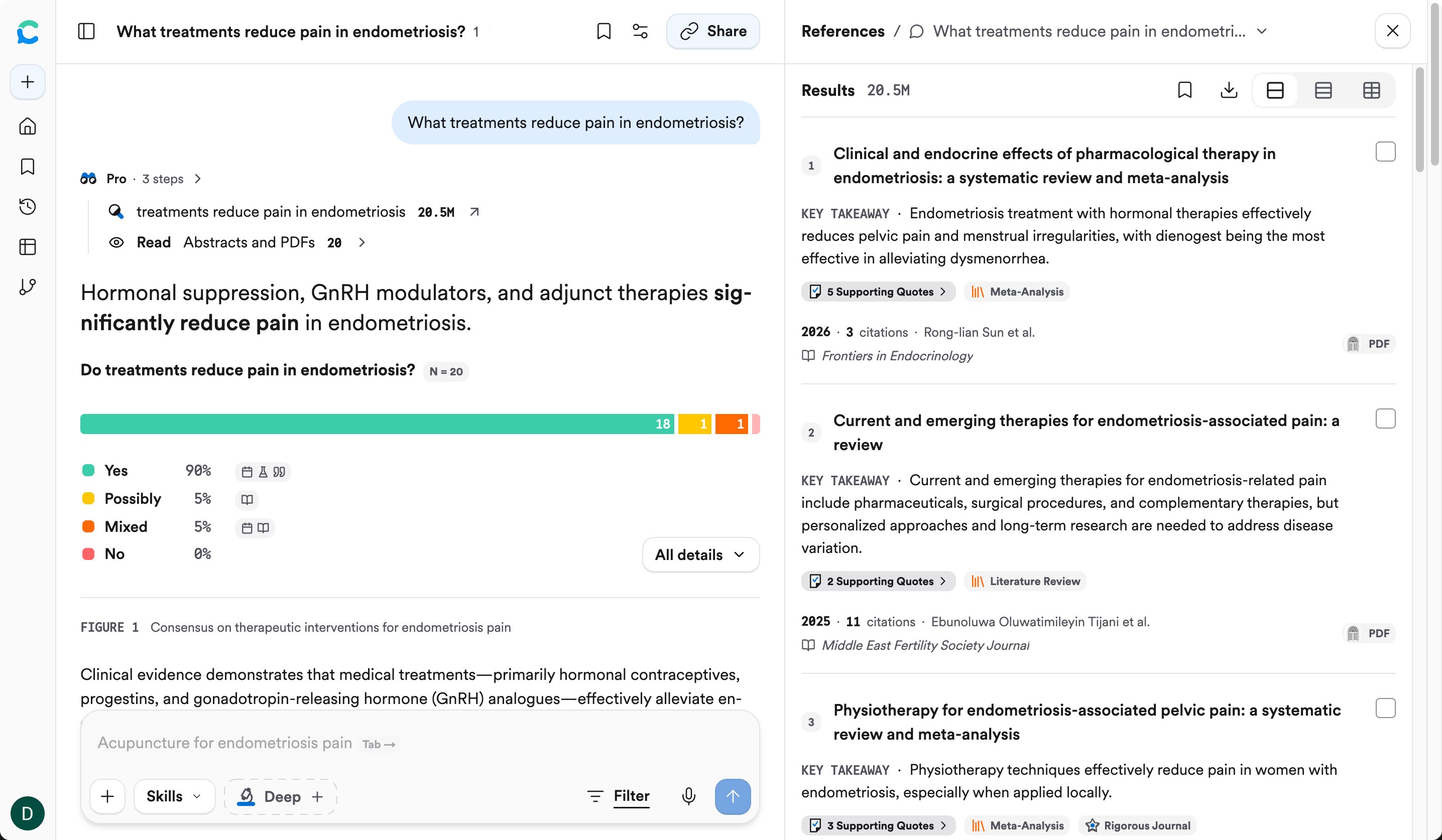 * **At the top of the answer** you'll see the steps Consensus took, like **Pro · 3 steps**: what it searched for, how many papers matched, and how many it read. Click it to see the details.
* **The answer** summarizes what the research says. For a yes/no question you'll also see a meter showing how many papers lean yes, possibly, mixed, or no. The grey tags in the text (like `Sun 2026`) are citations.
* **The References panel** lists the papers behind the answer, each with a one-line key takeaway, its supporting quotes, a study-type badge, the year, and how often it's been cited.
The next group, [Understand your results](/learn/read-a-consensus-answer), walks through all of this in detail.
## Step 4: Ask a follow-up
Type in the **Ask a follow up** box under the answer. Consensus remembers the conversation, so you can narrow it down without starting over:
```text theme={null}
Only include studies from the last 5 years.
```
```text theme={null}
Which of these are randomized controlled trials?
```
## Try it on your topic
Type 2–4 keywords about your topic and look at what comes back.
Turn it into a question you actually want answered and search again. Compare the two answers.
Narrow it by year, study type, or population.
**You should now have:** one search on your own topic, phrased as a question, with at least one follow-up.
* Search for a specific paper with its DOI or title, or for a researcher by name.
* Boolean operators (`AND`, `OR`, `NOT`) work if you're used to them.
* See every filter in [Filter for strong, recent studies](/search-basics/find-high-quality-recent-papers#every-filter-explained).
* See what happens behind the scenes in [Paper search](/get-started/how-search-works).
This documentation is built and hosted on [Mintlify](https://mintlify.com), a developer documentation platform.
* **At the top of the answer** you'll see the steps Consensus took, like **Pro · 3 steps**: what it searched for, how many papers matched, and how many it read. Click it to see the details.
* **The answer** summarizes what the research says. For a yes/no question you'll also see a meter showing how many papers lean yes, possibly, mixed, or no. The grey tags in the text (like `Sun 2026`) are citations.
* **The References panel** lists the papers behind the answer, each with a one-line key takeaway, its supporting quotes, a study-type badge, the year, and how often it's been cited.
The next group, [Understand your results](/learn/read-a-consensus-answer), walks through all of this in detail.
## Step 4: Ask a follow-up
Type in the **Ask a follow up** box under the answer. Consensus remembers the conversation, so you can narrow it down without starting over:
```text theme={null}
Only include studies from the last 5 years.
```
```text theme={null}
Which of these are randomized controlled trials?
```
## Try it on your topic
Type 2–4 keywords about your topic and look at what comes back.
Turn it into a question you actually want answered and search again. Compare the two answers.
Narrow it by year, study type, or population.
**You should now have:** one search on your own topic, phrased as a question, with at least one follow-up.
* Search for a specific paper with its DOI or title, or for a researcher by name.
* Boolean operators (`AND`, `OR`, `NOT`) work if you're used to them.
* See every filter in [Filter for strong, recent studies](/search-basics/find-high-quality-recent-papers#every-filter-explained).
* See what happens behind the scenes in [Paper search](/get-started/how-search-works).
This documentation is built and hosted on [Mintlify](https://mintlify.com), a developer documentation platform.