> ## Documentation Index
> Fetch the complete documentation index at: https://docs.consensus.app/llms.txt
> Use this file to discover all available pages before exploring further.
# Where do papers come from
> Consensus has the second-largest research index in the world: abstracts and metadata for 220 million peer-reviewed papers, open-access full text, and paywalled full text through publisher partnerships, updated weekly.
Consensus searches a database of over 220 million peer-reviewed research papers from journals worldwide. It covers every domain of science, from astronomy to sociology to biochemistry, and is updated weekly.
## Sources
Consensus has the second-largest research index in the world, after Google Scholar. It's built by aggregating a wide range of sources in three layers:
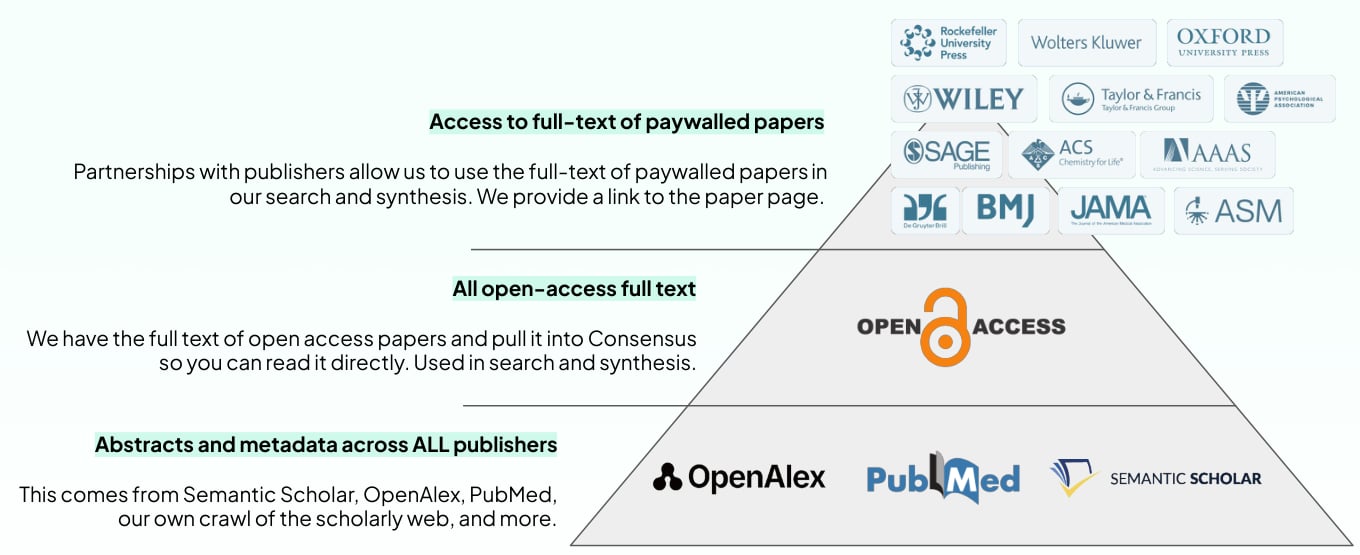 Every paper in the index has its abstract and metadata, regardless of publisher. This layer comes from:
* **Semantic Scholar**, which draws on over 50 direct partnerships with publishers, data providers, and aggregators covering more than 500 journals, university presses, and scholarly societies.
* **OpenAlex**, an open database that connects papers, authors, institutions, journals, and topics worldwide.
* **PubMed**, over 37 million biomedical and life-science records.
* **Consensus's own crawl of the scholarly web**, which fills the coverage gaps the aggregators miss.
Consensus pulls in the full text of every open-access paper. That lets it read the whole paper, not just the abstract, when searching and synthesizing, and lets you see exactly where in the paper each piece of information comes from.
Partnerships with publishers allow Consensus to use the full text of paywalled papers in its search and synthesis. We provide a link to the paper page. Consensus doesn't replace your subscription; it complements it.
Partners include Wiley, Taylor & Francis, SAGE, Wolters Kluwer, Oxford University Press, the American Chemical Society, De Gruyter Brill, BMJ, the American Psychological Association, AAAS, JAMA Network, the American Society for Microbiology, Rockefeller University Press, and many more. See [Full text access](/get-started/full-text-access).
Together, these layers cover nearly all of the highest-impact journals and the entirety of PubMed.
## What's in the index
* **Primarily peer-reviewed journal articles**, along with some conference papers and preprints.
* **Preprints are included and labeled.** Use the **Exclude preprints** filter (or `exclude_preprints` in the API and MCP) to keep only peer-reviewed work.
* **Retracted papers are marked** with a RETRACTED badge and are never used in AI analyses or summaries.
* **Q1 journal coverage** across disciplines, including Nature, Cell, NEJM, JAMA, American Economic Review, Econometrica, and Chemical Reviews. Q1 means the top 25% of journals in a field by SCImago Journal Rank.
## You can control what you search
### Select your corpus
Open the **Corpus** dropdown in the search bar to choose what Consensus searches.
| Corpus | What it searches |
| ------------ | ------------------------------------------------------------------------------------------------------------------------------------------------------------------------------------------------------------------------------------------------------------------- |
| All | The complete dataset of 220M+ peer-reviewed papers |
| Medical mode | A curated subset of \~8 million papers and 50,000 clinical guidelines from the top 1,000 medical journals, selected using Impact Factor, SJR score, and SciScore's Rigor and Transparency Index. Examples: NEJM, Cochrane, JAMA, BMJ, Circulation, Nature Medicine. |
| Your library | Papers you've imported from Zotero or uploaded yourself. Search a specific Collection or your whole [Library](/core-features/library), on its own or combined with the broader index in the same search. |
### More control over the papers that surface
Consensus has a number of proprietary filters built for researchers. These include:
* **19 study types**, from RCTs and cohort studies to systematic reviews and meta-analyses
* **Country**, where the study population is from
* **Journals**, by SCImago journal rank
* **Publishers**, with 44 to choose from
Plus publication year, citation count, sample size, study duration, human or animal setting, open access, and preprints. Queries can also include DOIs, author names, paper titles, MeSH synonyms, and Boolean operators.
The full list of filters, what each one does, and how to apply them.
## Next
What happens between your query and the answer.
Which papers Consensus can read in full, and how.
Every paper in the index has its abstract and metadata, regardless of publisher. This layer comes from:
* **Semantic Scholar**, which draws on over 50 direct partnerships with publishers, data providers, and aggregators covering more than 500 journals, university presses, and scholarly societies.
* **OpenAlex**, an open database that connects papers, authors, institutions, journals, and topics worldwide.
* **PubMed**, over 37 million biomedical and life-science records.
* **Consensus's own crawl of the scholarly web**, which fills the coverage gaps the aggregators miss.
Consensus pulls in the full text of every open-access paper. That lets it read the whole paper, not just the abstract, when searching and synthesizing, and lets you see exactly where in the paper each piece of information comes from.
Partnerships with publishers allow Consensus to use the full text of paywalled papers in its search and synthesis. We provide a link to the paper page. Consensus doesn't replace your subscription; it complements it.
Partners include Wiley, Taylor & Francis, SAGE, Wolters Kluwer, Oxford University Press, the American Chemical Society, De Gruyter Brill, BMJ, the American Psychological Association, AAAS, JAMA Network, the American Society for Microbiology, Rockefeller University Press, and many more. See [Full text access](/get-started/full-text-access).
Together, these layers cover nearly all of the highest-impact journals and the entirety of PubMed.
## What's in the index
* **Primarily peer-reviewed journal articles**, along with some conference papers and preprints.
* **Preprints are included and labeled.** Use the **Exclude preprints** filter (or `exclude_preprints` in the API and MCP) to keep only peer-reviewed work.
* **Retracted papers are marked** with a RETRACTED badge and are never used in AI analyses or summaries.
* **Q1 journal coverage** across disciplines, including Nature, Cell, NEJM, JAMA, American Economic Review, Econometrica, and Chemical Reviews. Q1 means the top 25% of journals in a field by SCImago Journal Rank.
## You can control what you search
### Select your corpus
Open the **Corpus** dropdown in the search bar to choose what Consensus searches.
| Corpus | What it searches |
| ------------ | ------------------------------------------------------------------------------------------------------------------------------------------------------------------------------------------------------------------------------------------------------------------- |
| All | The complete dataset of 220M+ peer-reviewed papers |
| Medical mode | A curated subset of \~8 million papers and 50,000 clinical guidelines from the top 1,000 medical journals, selected using Impact Factor, SJR score, and SciScore's Rigor and Transparency Index. Examples: NEJM, Cochrane, JAMA, BMJ, Circulation, Nature Medicine. |
| Your library | Papers you've imported from Zotero or uploaded yourself. Search a specific Collection or your whole [Library](/core-features/library), on its own or combined with the broader index in the same search. |
### More control over the papers that surface
Consensus has a number of proprietary filters built for researchers. These include:
* **19 study types**, from RCTs and cohort studies to systematic reviews and meta-analyses
* **Country**, where the study population is from
* **Journals**, by SCImago journal rank
* **Publishers**, with 44 to choose from
Plus publication year, citation count, sample size, study duration, human or animal setting, open access, and preprints. Queries can also include DOIs, author names, paper titles, MeSH synonyms, and Boolean operators.
The full list of filters, what each one does, and how to apply them.
## Next
What happens between your query and the answer.
Which papers Consensus can read in full, and how.