Consensus MCP lets AI assistants search 400+ million peer-reviewed research papers. Connect your preferred client below. You’ll be searching in under 2 minutes

What you can build with the Consensus MCP

MCP is the fastest way to give an assistant or agent paper search. Owkin plugged Consensus MCP into its agentic AI scientist and went from curated PubMed abstracts to 25x the paper coverage in days. Browse the use cases.
Server URL
claude-card

Claude

Add Consensus from the Claude connectors directory.
chatgpt-card

ChatGPT

Add Consensus from the ChatGPT app directory.
copilot-card

Microsoft 365 Copilot

Add Consensus for Copilot from the Microsoft Marketplace.

Connect Your Client

One-click: open Consensus in the Claude directory and click Connect. Or connect manually:
1

Open Settings

Open claude.ai or the Claude desktop app and go to Settings.
2

Browse connectors

Select Connectors, then Browse connectors.
3

Find Consensus

Search for Consensus and click Connect.
4

Sign in

Approve the sign-in with your Consensus account, or continue without one at reduced limits.
5

Start searching

Ask a research question in any chat. Consensus appears in the tools menu.
OAuth will open in your browser automatically on first use. You can also trigger it manually with the /mcp command inside Claude Code.
One-click: open Consensus in the ChatGPT app directory and click Connect. Or connect manually:
1

Open ChatGPT

Open chatgpt.com and sign in.
2

Find Consensus

Open Apps from the sidebar, search for Consensus, and click Connect.
3

Sign in

Sign in with your Consensus account when prompted.
4

Start searching

Ask a research question, or call it by name: “Use Consensus to find RCTs on…”
Search results display in an interactive widget showing top papers with citations and direct links.
Consensus also works with ChatGPT Deep Research. See Using Consensus with ChatGPT Deep Research below.
Or add to ~/.codex/config.toml:
One-click: Install in Cursor. Or add to ~/.cursor/mcp.json:
Add to your MCP configuration:
Add Consensus as a custom app for Gemini Spark:
1

Open Connected Apps

Go to gemini.google.com and sign in with a personal Google Account, then click Settings & help → Connected Apps.
2

Add a custom app

Under Custom apps for Spark, click Add a custom app and paste the server URL:
3

Approve the connection

Click Next and follow the prompts to finish OAuth. If your client doesn’t support Dynamic Client Registration, expand Advanced features and enter your credentials.
4

Start searching

Ask Gemini Spark a research question and it can call Consensus tools.
Requires access to Gemini Spark, a personal Google Account, Keep Activity turned on, and is currently available in the US. Workspace and school accounts are not supported yet.
In Microsoft 365 Copilot, Consensus is a connector your admin sets up for the tenant. Once it’s there, connect it yourself under Sources.
1

Open Copilot Chat settings

In Microsoft 365 Copilot, select the gear icon at the bottom of the left sidebar, then Settings, then Sources.
2

Connect Consensus

Find Consensus for Copilot and select Connect, then sign in with your Consensus account.
3

Ask a research question

Type a research question like ‘What does the research say about creatine and cognitive function?’ and Copilot will call Consensus to find relevant papers.
Don’t see Consensus under Sources? Your admin needs to add it first. Send them the Microsoft 365 Copilot admin guide. A Consensus account is required and free to create.
This allows you to add Consensus as a custom tool in Copilot studio so it can be used with agents or other automations you have have. This type of authentication will 
1

Open custom tools

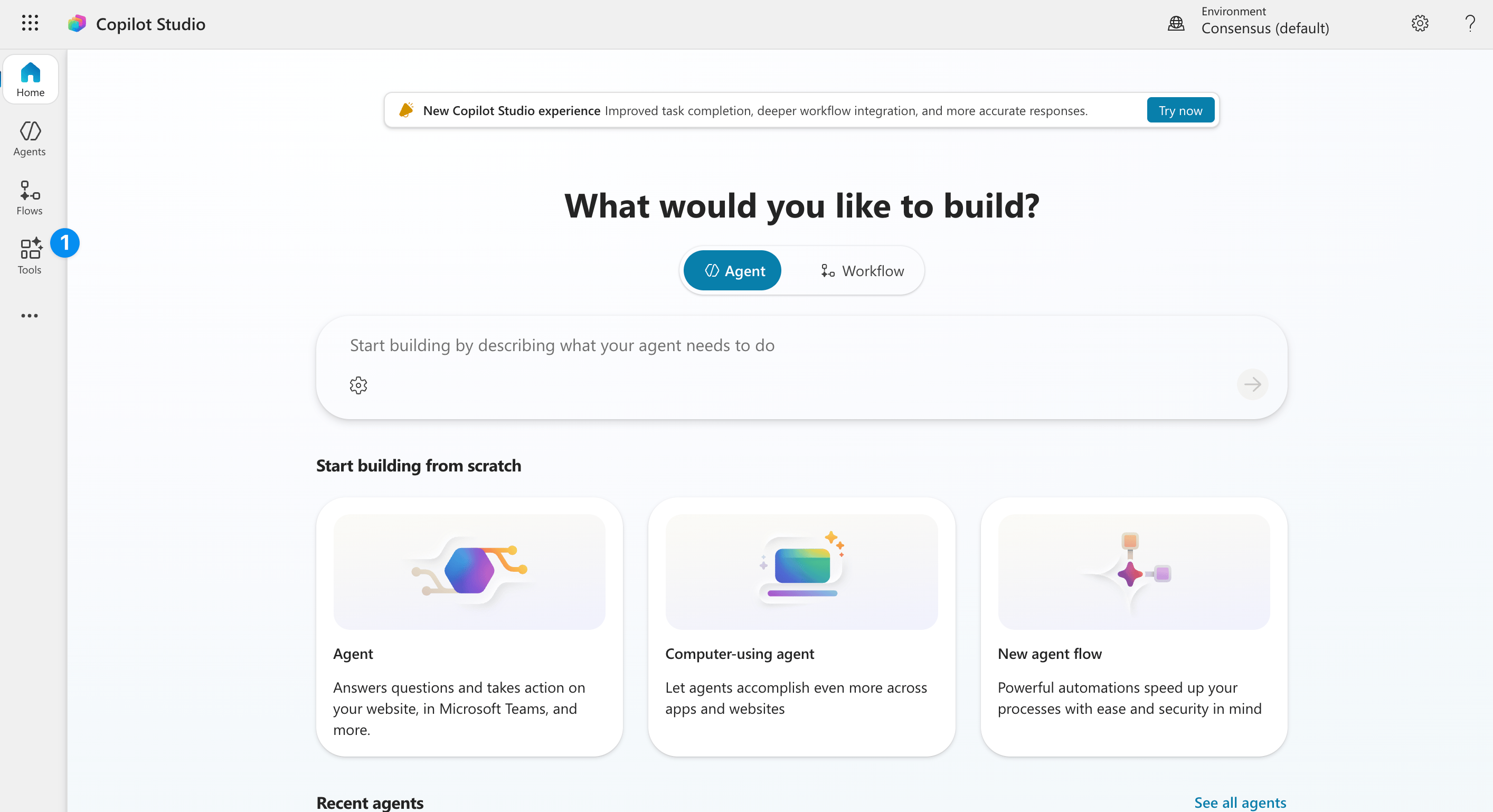
Go to Copilot studio and find the ‘tools’ tab on the left hand side.Clean Shot 2026 08 31 At 17 17 16@2x
2

Create 'Create new tool'

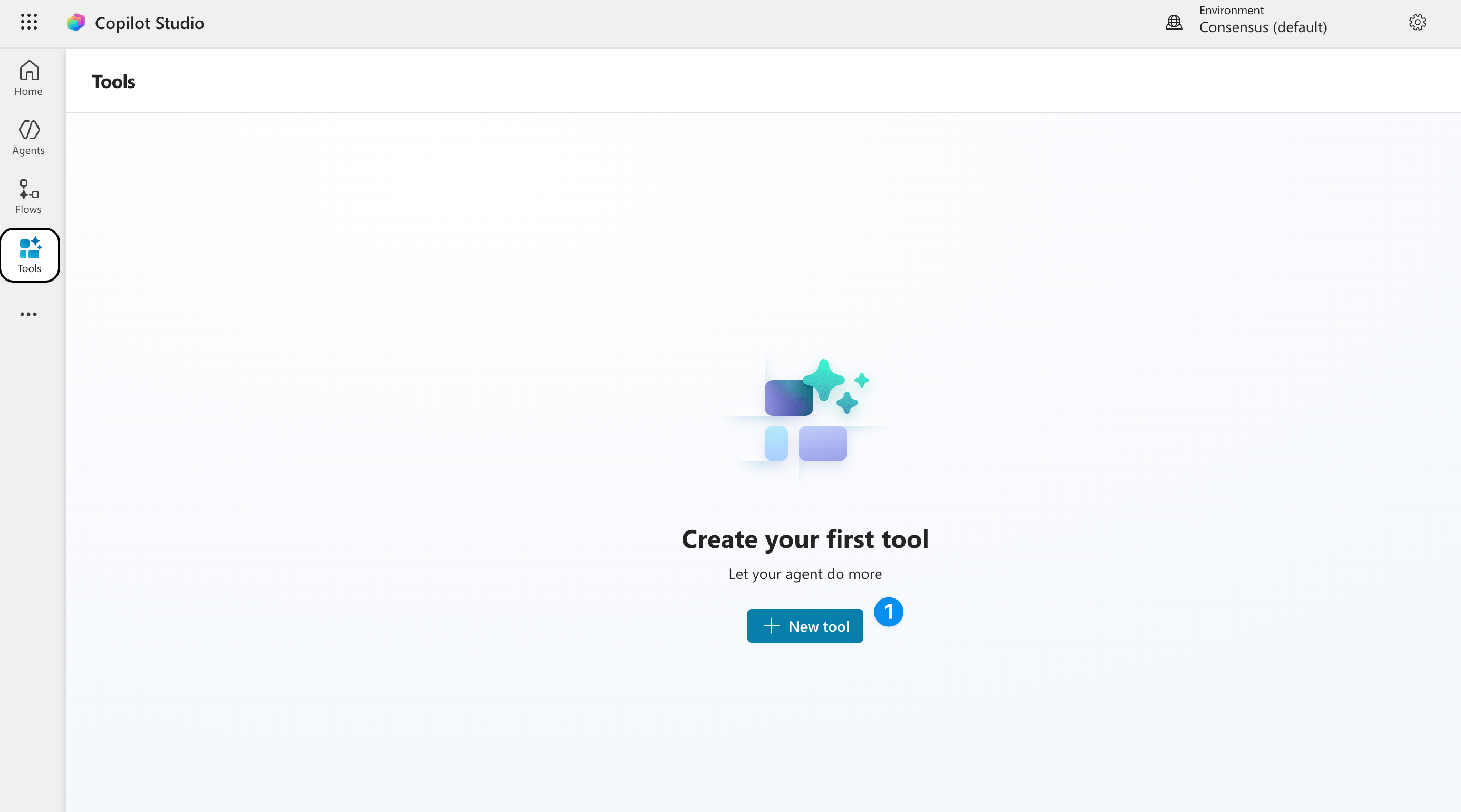
Clean Shot 2026 08 31 At 17 19 50@2xClick ‘new tool’ to add a custom tool
3

Click 'Model context protocol'

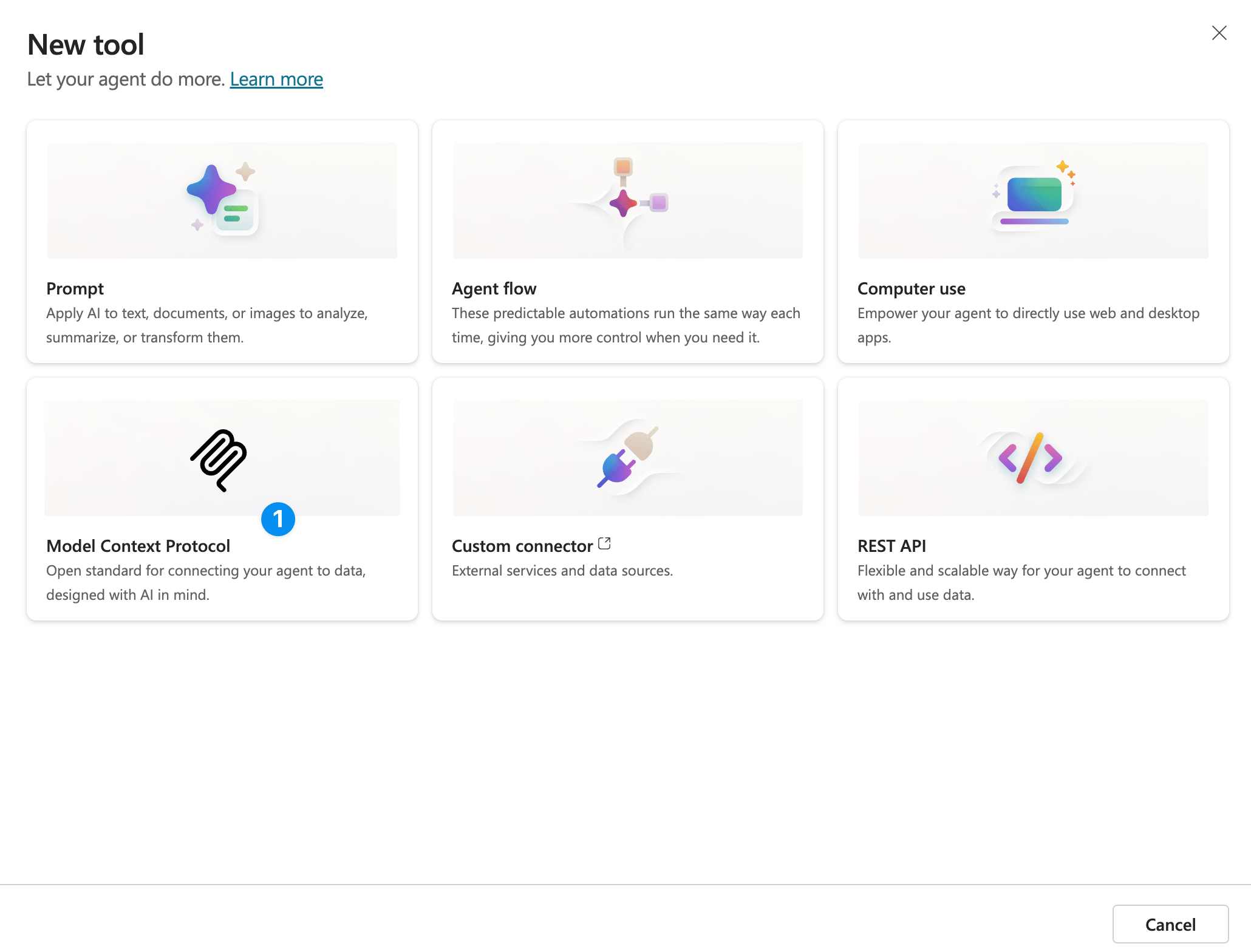
Clean Shot 2026 08 31 At 17 21 06@2xYou can also use the API to do this. But to use the MCP, click ‘model context protocol’.
4

Fill in the connector information

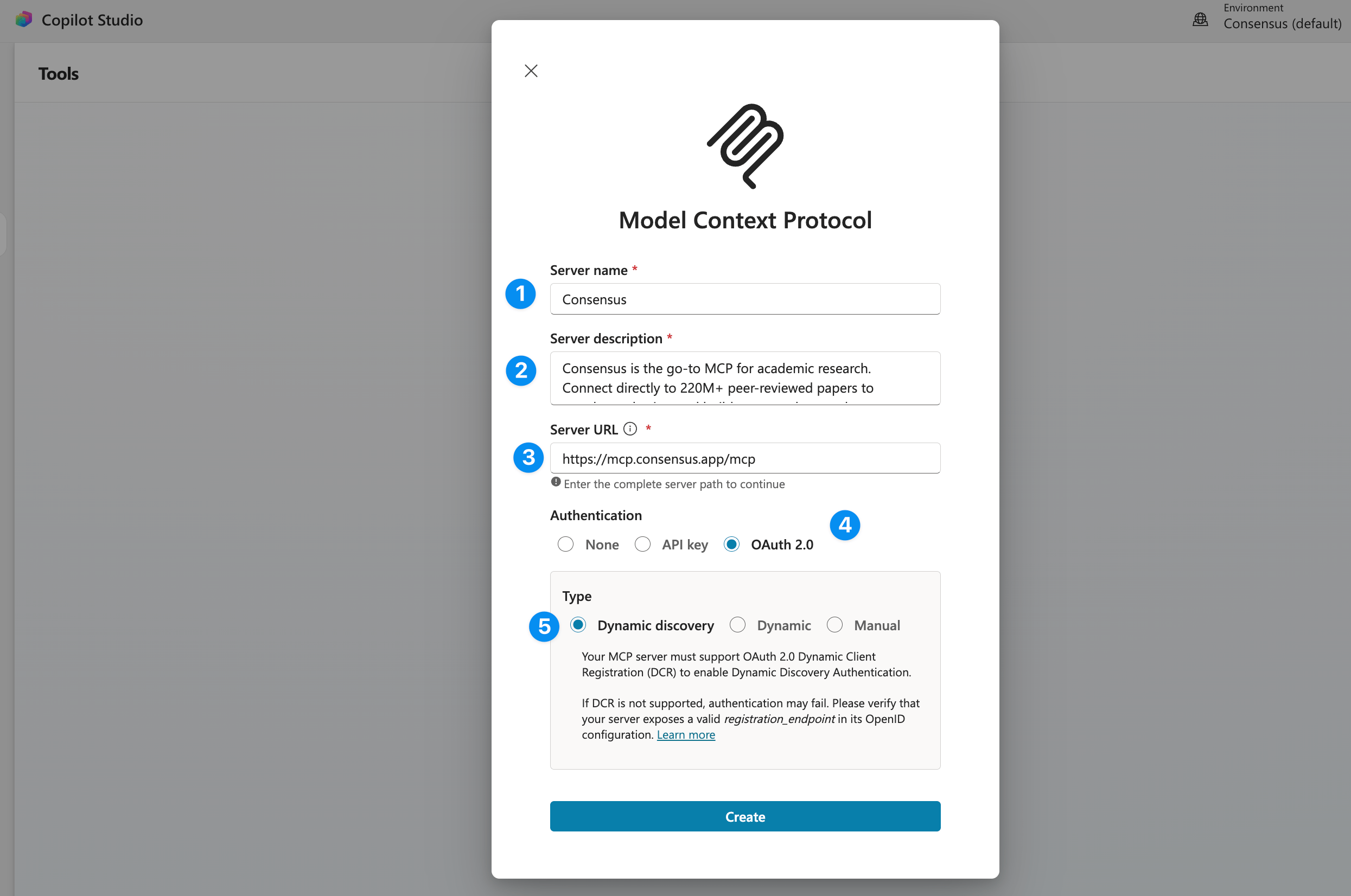
Clean Shot 2026 08 31 At 17 27 17@2xServer nameConsensusServer DescriptionConsensus is the go-to MCP for academic research. Search 400M+ peer-reviewed papers from PubMed, Semantic Scholar, and ArXiv — filter by study type (RCTs, meta-analyses, systematic reviews), journal quality, sample size, and more. Get structured results with citations, study takeaways, and direct links, or run pre-built workflows for literature reviews, grant research, and evidence synthesis.Server URLhttps://mcp.consensus.app/mcpAuthenticationOAuth 2.0TypeDynamic Discovery
5

Save and use!

Thats it! This custom tool can now be used and shared with other team members. Each team member will be able to connect to their own Consensus account when they use the tool.
A Consensus account is required. It is free to create.
Use an API key for clients without OAuth, headless agents, and server-side automations. Send it in the Authorization header on every request to https://mcp.consensus.app/mcp:
Create a key from your profile icon under API & MCP Dashboard → Keys and clients → New key. The key gets its owner’s plan limits and draws from the same monthly pool as the API. See MCP plans and access.JSON config (Cursor, VS Code, and most clients that accept headers):
Claude Code:
An invalid or revoked key doesn’t return an error. The server falls back to no-account limits (3 papers per search), so if you only get 3 results, check your key.
Keep the key server-side. Don’t paste it into prompts or commit it to a repo.
Any client that supports remote MCP servers (Streamable HTTP) works. Point it at https://mcp.consensus.app/mcp. If your client supports OAuth, authentication is handled automatically.
Pick your client for step-by-step setup.

Watch: connect Consensus and run your first search

Using Consensus with ChatGPT Deep Research

Consensus also works with ChatGPT Deep Research. When Deep Research uses the Consensus app, it can search Consensus for relevant papers and retrieve full paper details for cited results.
1

Connect the Consensus app

Connect the Consensus app in ChatGPT using the steps above.
2

Start a Deep Research request

Start a Deep Research request in ChatGPT.
3

Ask ChatGPT to use Consensus

Ask ChatGPT to use Consensus for peer-reviewed research, for example:
Use Consensus to research the evidence on exercise for depression. Prioritize systematic reviews, meta-analyses, and randomized controlled trials.
Deep Research may run multiple Consensus searches, refine filters, retrieve paper details, and return a cited synthesis with direct links to papers on Consensus.

Verify Your Connection

Try one of these in your connected client. Each link opens the question pre-filled: You should see results citing specific papers with titles, journals, years, citation counts, and direct links.

Plans and Access

Your Consensus plan, not your AI subscription, sets how many papers each search returns, your monthly calls, and whether results include DOIs and full-text excerpts. No account is needed to try it.

Plans and access

Limits for every plan, how calls are counted, additional usage, and API key access.

Search Tool

The search tool searches Consensus for peer-reviewed research papers. ChatGPT Deep Research may call this tool multiple times with different queries and filters while building a research report.

Parameters

Response

The search tool returns a text payload containing ranked papers (title, link, authors, year, citation count, journal, and abstract), citation instructions, and any instructions for best rendering practices — everything an agent needs to answer with cited, linked sources.
Paid plans also get DOIs and, with include_full_text_chunks, full-text excerpts. In ChatGPT, results appear in the Consensus widget.
Need structured JSON? Use the Consensus API, which shares your monthly allowance with MCP.

Example Prompts

  • “What does the research say about the effectiveness of remote work on productivity?”
  • “Find RCTs and meta-analyses since 2020 on cognitive behavioral therapy for anxiety”
  • “Search for high quality human studies on gut microbiome and mental health with at least 100 participants”
  • “Recent research on large language model hallucination from top tier journals”
  • “Use Consensus Deep Research to compare evidence for different treatments for insomnia”

Troubleshooting

You added the server with -- --transport http instead of --url. Remove and re-add:
Fully quit and restart Claude Code. Do not just use the reconnect option. Your credentials are saved and will work after restart.
Your OAuth token has expired. Re-authenticate:
  • Claude Code: Type /mcp, select Consensus, choose Clear authentication, re-authenticate, then restart Claude Code
  • Codex: Run codex mcp logout consensus then codex mcp login consensus
  • Cursor: Disconnect and reconnect the server in Settings then Tools and MCP
  • Claude Desktop: Disconnect and reconnect the connector in Settings then Connectors
  • ChatGPT: Disconnect and reconnect the Consensus app from ChatGPT Apps
  • Verify the URL includes /mcp at the end
  • Remove and re-add the server using the commands above
  • Restart your client completely
This is normal. Claude loads tool definitions on demand when many tools are present. Retry the query and it will work on the second attempt.
Confirm the Consensus app is connected in ChatGPT Apps, then ask Deep Research to use Consensus explicitly. For example:
Use Consensus to find peer-reviewed papers on this question and cite the strongest evidence.
Deep Research decides when to call connected tools, so it may not call Consensus for questions that are not research-focused.
Try broadening your search query or removing filters. Use specific academic terminology rather than casual language.
Paid plans can continue making calls past the included monthly limit when the account has an active metered API subscription and additional usage is enabled; extra usage is billed at $0.05 per call, with each call covering up to 100 papers. Free plans must wait for the next monthly reset or upgrade.
Rate limits are per user for authenticated MCP clients. A 429 that says you’re sending requests too quickly is a per-minute rate limit; wait a few moments and add backoff between requests. A 429 that mentions monthly call credits is a usage limit, not a rate limit.

Security

  • Endpoint: Only connect to the official URL: https://mcp.consensus.app/mcp
  • API keys: Store securely using environment variables. Never share keys in prompts or public conversations. Rotate if compromised.
  • Data handling: Search queries are sent to the Consensus API over HTTPS/TLS. Results contain publicly available academic paper metadata. No personal data is stored from MCP requests.

Supported Platforms

Additional Resources

Consensus Website

Explore the Consensus research platform.

API Documentation

Structured JSON results for pipelines and integrations.

MCP Specification

Learn more about the Model Context Protocol.

MCP server on GitHub

View the source, report issues, and star the Consensus MCP server.