
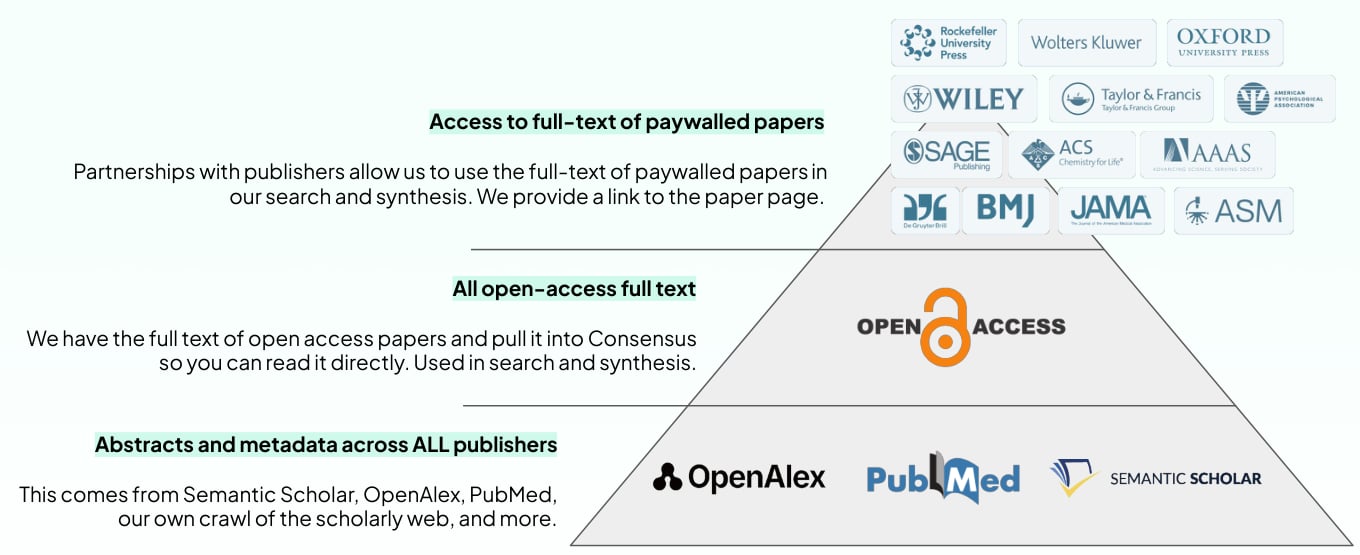
The Consensus index: abstracts and metadata from Semantic Scholar, OpenAlex and PubMed for every paper, all open-access full text, and full text of paywalled papers from publisher partners.
What each API does best
Semantic search compared
OpenAlex and Semantic Scholar both offer some form of search by meaning, with limits worth knowing.- OpenAlex semantic search (
search.semantic) embeds each work’s title, abstract and venue name. It returns up to 50 results per query, at 1 request a second, and supports 17 filters. Filters such ascited_by_countaren’t supported7. Its regularsearchmatches title, abstract, full text and keywords8. - Semantic Scholar offers relevance search (up to 1,000 ranked results), Boolean bulk search, and snippet search, which returns passages of about 500 words from the paper body9.
- Crossref searches bibliographic metadata4.
- Consensus runs semantic and keyword search together over 400M+ articles and ranks for scientific relevance. Every filter combines with the search, and a query returns up to 1,000 results.
Evidence metadata
Enrich Consensus results with open metadata
Every Consensus result carries adoi. Use it to pull what the open APIs do best. DOI lookups are free in OpenAlex11.
Python
Licences and terms
- OpenAlex: all data is CC01.
- Semantic Scholar: data is licensed CC BY-NC or ODC-BY, and you must attribute Semantic Scholar. AI2 uses the data you send to the API to provide and improve it12.
- Crossref: most metadata isn’t subject to copyright and can be used for any purpose. Some abstracts are copyrighted by publishers or authors4.
- Consensus: customer data isn’t used to train AI models. See Pricing, rate limits and data privacy.
The same question on each API
- Consensus
- OpenAlex
- Semantic Scholar
- Crossref
cURL
Related
Compare scholarly APIs
Why teams choose Consensus, and every API at a glance.
Where the papers come from
How Consensus builds its index from open metadata, its own crawl and publisher full text.
Sources
Facts about other providers were checked against their official documentation on 5 November 2026. Limits and prices change, so check the source before you build on a number.- OpenAlex pricing: all data CC0; $1 of free API usage a day with a key; annual plans from $5,000 a year; the whole database can be downloaded as a snapshot refreshed every quarter. A keyless response notes that it shares a $0.10 daily budget per IP address.
- OpenAlex works: more than 320 million works in the core catalog.
- Semantic Scholar API overview: 214 million papers; unauthenticated requests share 1,000 requests a second across all users and may be throttled under heavy use; the introductory limit for an API key is 1 request a second. The API also serves SPECTER2 embeddings and a Recommendations service for similar papers.
- Crossref REST API: bibliographic metadata including funding, licence and abstracts; no sign-up required; most metadata isn’t subject to copyright.
- Tips for using the Crossref REST API: annual public data file.
total-resultsfromhttps://api.crossref.org/works?rows=0on 5 November 2026: 188,499,975.- OpenAlex semantic search: embeds title, abstract and venue name; up to 50 results per query; 1 request a second; 17 supported filters, and others such as
cited_by_countreturn a 400 error. - OpenAlex search:
search=matches works by title, abstract, full text and keywords; Boolean and phrase searches are supported. - Semantic Scholar Academic Graph API reference:
/paper/search(up to 1,000 relevance-ranked results),/paper/search/bulk(Boolean),/snippet/search(passages of about 500 words from title, abstract and body), and thepublicationTypes,minCitationCountandvenuefilters. - OpenAlex study designs: seven designs tagged automatically from title and abstract; each value right at least 96% of the time.
- OpenAlex single entities: lookups by ID or DOI, such as
/works/doi:10.7717/peerj.4375, are free. - Semantic Scholar API License Agreement: AI2 uses the data you send to call the API “for the purpose of providing and improving the API”; data is licensed CC BY-NC or ODC-BY; attribution required.