
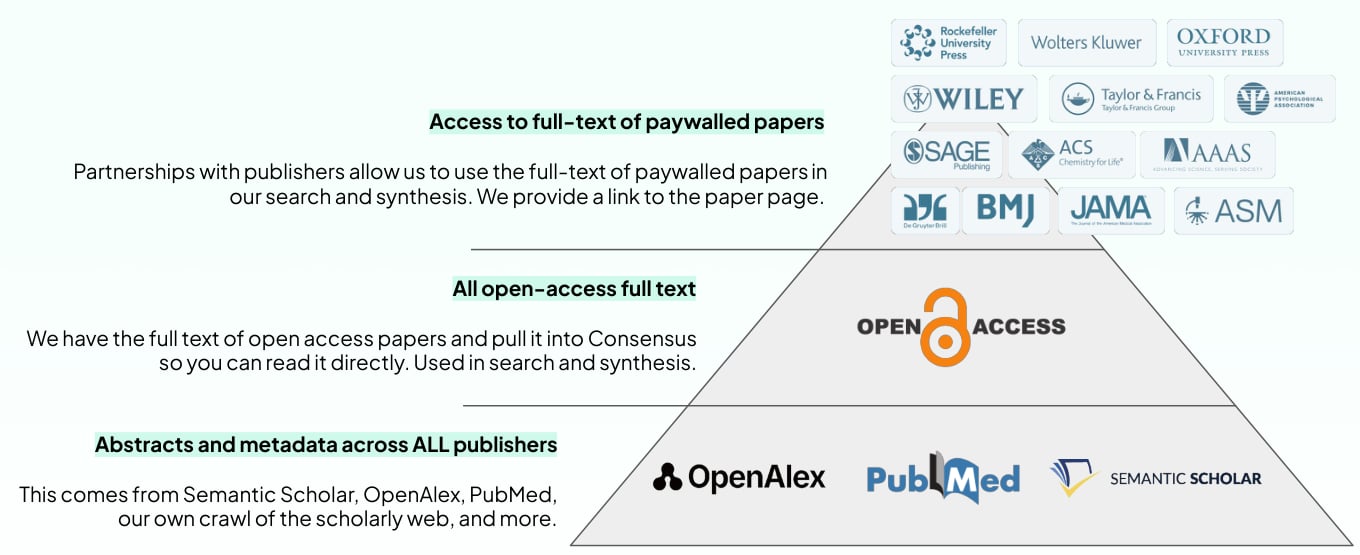
All of PubMed is one source in the Consensus index, alongside Semantic Scholar, OpenAlex, all open-access full text, and paywalled full text from publisher partners.
What each API does best
Semantic search over PubMed’s records
PubMed matches the terms in your query, mapping them to MeSH headings where it can, and can sort the matches with its Best Match algorithm3, 5. That works well when you know the vocabulary. A question worded differently from the abstracts that answer it can still miss them. Consensus searches the same records by meaning and by keyword together, then ranks the results for scientific relevance. You send the question as written, for example “does creatine improve working memory in older adults”, and get the most relevant papers first. Boolean operators and exact phrases still work when you want them. Europe PMC also matches keywords, but against full text as well as abstracts, so it can find papers whose abstracts never use your terms2.Filtering by study design and evidence quality
All three APIs let you narrow results by study type. Consensus adds the other signals a reviewer looks at.
Each Consensus result also returns its
study_type, sample_size, population_type and sjr_best_quartile, so your code can sort or grade the evidence after the search.
Top medical journals and clinical guidelines
Two Consensus filters are built for clinical work:medical_mode=truelimits results to about 8 million documents from the top 1,000 medical journals, plus about 50,000 clinical guidelines. Use it when general literature is too noisy.clinical_guideline=truereturns only papers classified as clinical guidelines.
When a Boolean strategy is the right tool
For the search you report in a systematic review, use a Boolean query in PubMed or Europe PMC. Reviewers can rerun it term for term, and it returns every match rather than a ranked top 1,000. Consensus fits around that search: scope the topic before you write the strategy, then check afterwards that the strongest studies on the question all made it into your set.Full text
- Consensus searches the full text of open-access papers and of paywalled papers from its publisher partners. On paid plans,
include_full_text_chunks=truereturns up to 3 query-relevant passages per paper from open-access papers. See Full text in the API. - PubMed has no full text. Its sister archive, PubMed Central, holds more than 10 million full-text records7.
- Europe PMC returns open-access articles as XML through
fullTextXML4.
The same question on each API
Consensus takes the question as written. PubMed and Europe PMC need it rewritten as terms and filters.- Consensus
- PubMed
- Europe PMC
Related
Compare scholarly APIs
Why teams choose Consensus, and every API at a glance.
Swap a hand-maintained paper corpus
How Owkin replaced a curated set of PubMed abstracts with Consensus.
Sources
Facts about other providers were checked against their official documentation on 5 November 2026. Limits and prices change, so check the source before you build on a number.- About PubMed: “more than 40 million citations and abstracts of biomedical literature”; “does not include full text journal articles”; a free resource.
- About Europe PMC: 49.2 million abstracts and 12.5 million full-text articles; searches abstracts and full text; searches can be limited to clinical trials, preprints or article sections such as Methods; free to anyone.
- PubMed User Guide: Boolean operators, field tags, MeSH and Best Match sorting.
- Europe PMC developer resources: REST, SOAP, OAI-PMH and FTP access to open-access content and metadata; automated bulk download of other content isn’t allowed. The Articles RESTful API includes
/{id}/fullTextXML. - E-utilities in depth, ESearch:
sort=relevanceis the default Best Match order on web PubMed. - NLM publication types.
- About PMC: “more than 10 million full-text article records”.