
Step 1: Cast a wide net
Consensus scans its entire index of 400M+ scholarly articles and matches your query against titles, abstracts, and full text (when available) using hybrid search: classic keyword search combined with AI-powered semantic search.- Semantic search, powered by AI embeddings, captures the intent behind your question, so conversational prompts and natural-language questions work.
- Keyword search, powered by BM25, anchors results to the exact terms in your query.
- Boolean operators and exact matching work too, for when you need precise control.
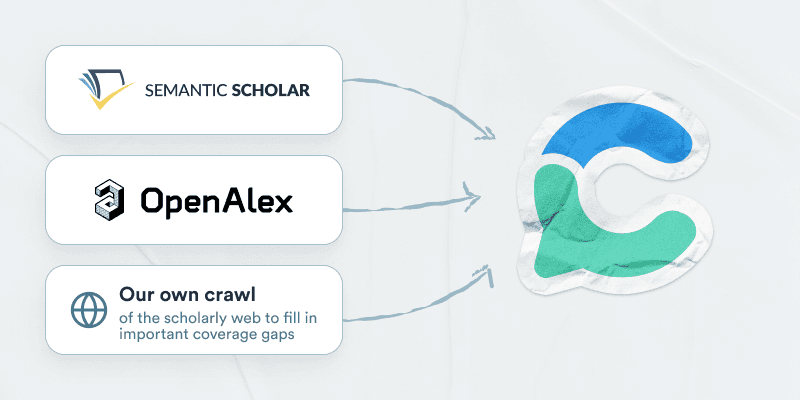
The index combines Semantic Scholar, OpenAlex, Consensus's own crawl of the scholarly web, and publisher partnerships.
Step 2: Refine by quality
The top 1,500 papers are re-ranked. The ranking logic is designed to mimic how a researcher weighs research:- About 80% is textual relevance: how well the paper actually matches your question.
- About 20% is research-quality signals, such as:
- Citation count: how often other researchers have cited the paper. Influence, not proof of validity.
- Recency: how recently it was published, so new work can surface alongside established papers.
- Journal reputation: the quality and impact of the journal it was published in.
Step 3: Rank the top 20 for precision
Consensus recalculates textual relevance on the top 20 papers using a larger, more compute-intensive model optimized for precision rather than broad recall. Quality signals still factor in, so the final list reflects both relevance and rigor.Step 4: Check relevance before writing anything
Before any AI summary is generated, separate checker models verify that each paper actually contains information relevant to the query. Papers that don’t meet the threshold are excluded. If nothing relevant is found, Consensus tells you rather than letting a model fill in gaps that don’t exist.Step 5: Analyze and synthesize
Once relevant papers are retrieved, AI is used in two ways:- Analyze individual papers — for example, the Study Snapshot, which extracts population, sample size, duration, location, methods, outcomes, and results.
- Synthesize across papers — the Pro answer, the Consensus Meter, claims and evidence tables, research gaps heat maps, and timelines.
How we measure search quality
Consensus tests its search head to head against the tools researchers already use:- Google Scholar: Consensus beat Google Scholar on retrieval accuracy by 10%.
- PubMed: Consensus beat PubMed on medical retrieval accuracy by 9%, as judged by third-party clinicians.
Why hallucinations are contained
Consensus only searches its index of academic literature, and every source it cites is tied to a real academic paper. On top of that, Consensus has a number of guardrails built in to prevent hallucinations. The most important is Citation Grounding, which shows you the exact sentence behind each claim and exactly where in the paper it comes from.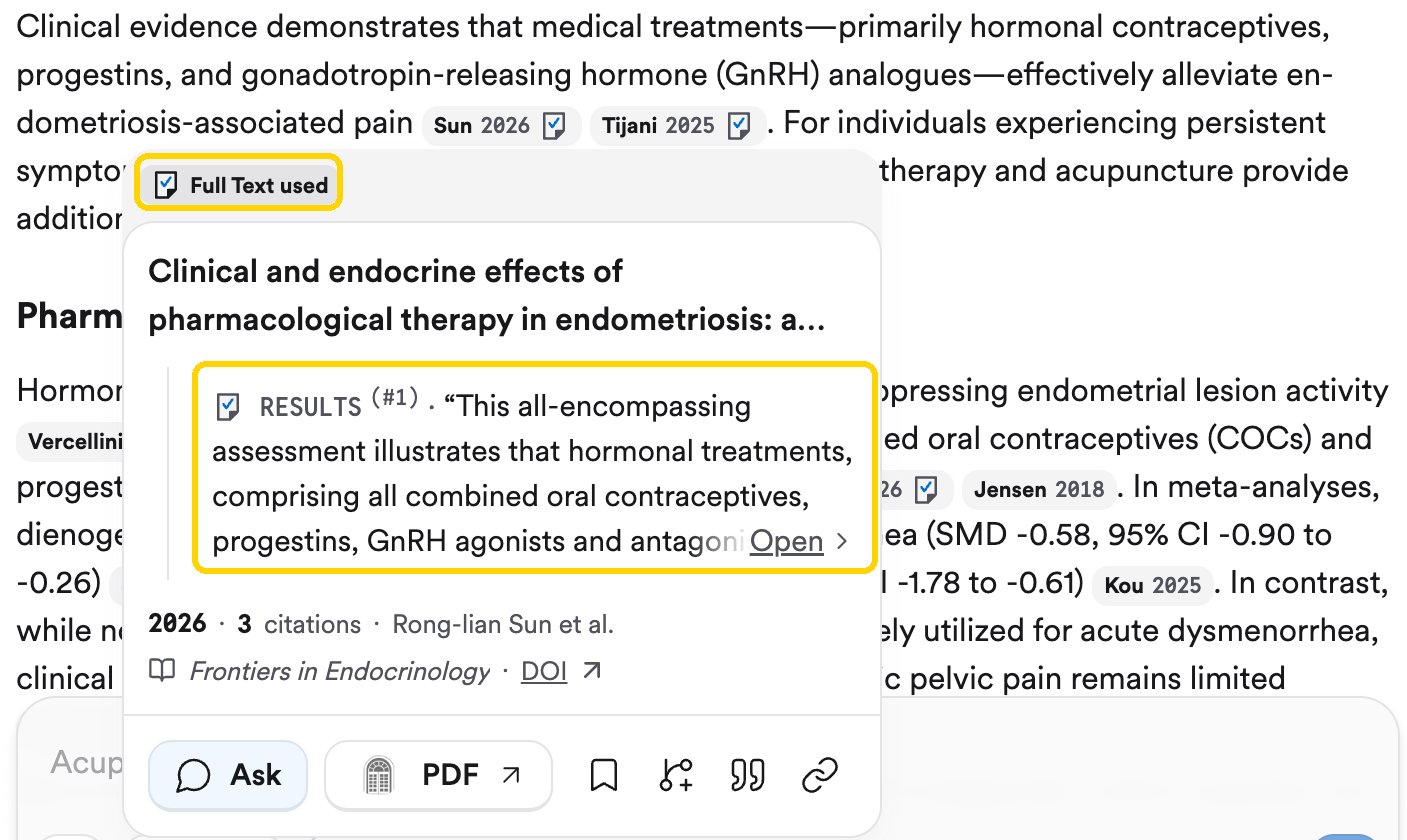
Hover a citation to see the exact quote behind it.
Consensus is built to help researchers find relevant papers faster. As always, it’s important to read the primary source material. Consensus has many features that show you exactly what’s happening at each step of the process and exactly where in a paper information comes from, so you can save time and go straight to the paper itself.
Next
Read the full paper
How full text sharpens retrieval and analysis.
Start here
The guide map and video playlist.