
A research gap is a question the literature hasn’t answered yet: a population nobody has studied, a method nobody has tried, or a result nobody has repeated. Gaps matter for two reasons. They tell you what’s missing from your own reading, and they’re often where new research projects come from.
This lesson works in two steps: find the gaps in the papers you’ve saved, then search the whole index to fill them. Pick the path that matches how many papers you have.
- A Collection (up to ~100 papers)
- Your whole Library (hundreds of papers)
A normal Pro search is enough for a project-sized Collection.
1
Ask for a gaps matrix
Open the Collection in My Library. It’s already attached to the search bar. (From anywhere else, click + in the search bar to attach it.)Consensus searches within the Collection, reads the relevant papers, and returns a grid of topics against populations. Empty cells are the gaps.
2
Fill the gaps from the full index
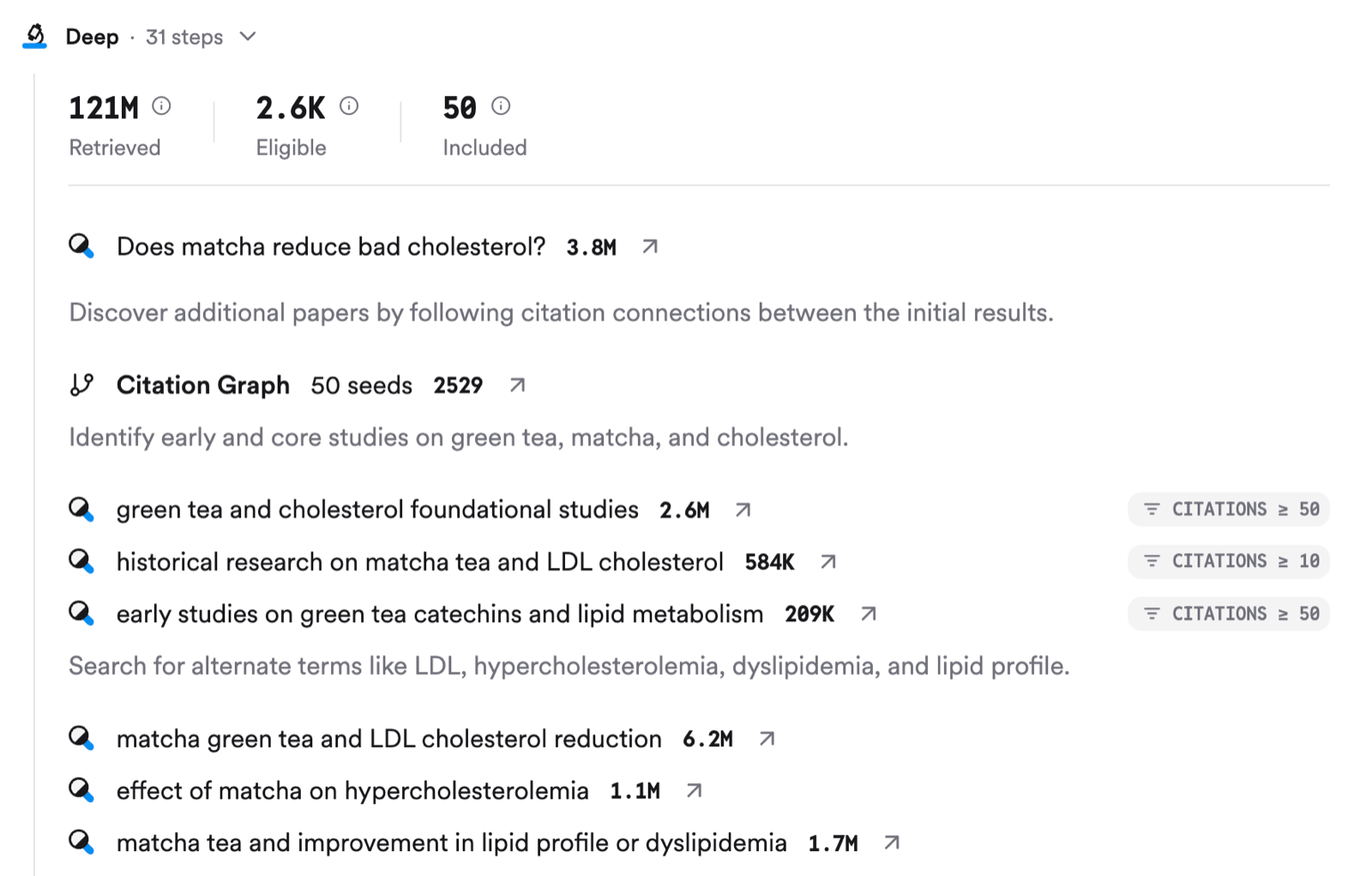
Remove the Collection from the search bar (click × on it, or choose + › Search corpus › All) so Consensus searches all 400M+ papers.Consensus remembers the gaps from your last question and runs one search per gap.
3
Save what you find
Open a paper and use Save to add it to the Collection, or select several papers in References and save them at once.
A gap in your Collection isn’t always a gap in the literature. Step 2 checks the difference: if the full index has plenty of papers on it, you just hadn’t found them yet. If it doesn’t, you may have found a real research gap, which is often where new projects start.
Try it on your topic
Run a gaps matrix on your project Collection, then search the full index to fill one of the gaps.You should now have: 2–3 gaps in your topic, and for each one, whether it’s a gap in your reading or in the research itself.
Go deeper: getting papers into a Collection
Go deeper: getting papers into a Collection
Click + Add in the top right of My Library to upload PDF, RIS, or BibTeX files (up to 20 at a time, 50 MB each, text-based PDFs only), paste DOIs, or import from Zotero. See Library for the full walkthrough, including Zotero import.
Go deeper: export the report
Go deeper: export the report
Scroll to the bottom of an answer and click Export: Copy text, Copy with citations (APA, MLA, Chicago, Harvard, LaTeX, AMA/Numeric), or Export as PDF.